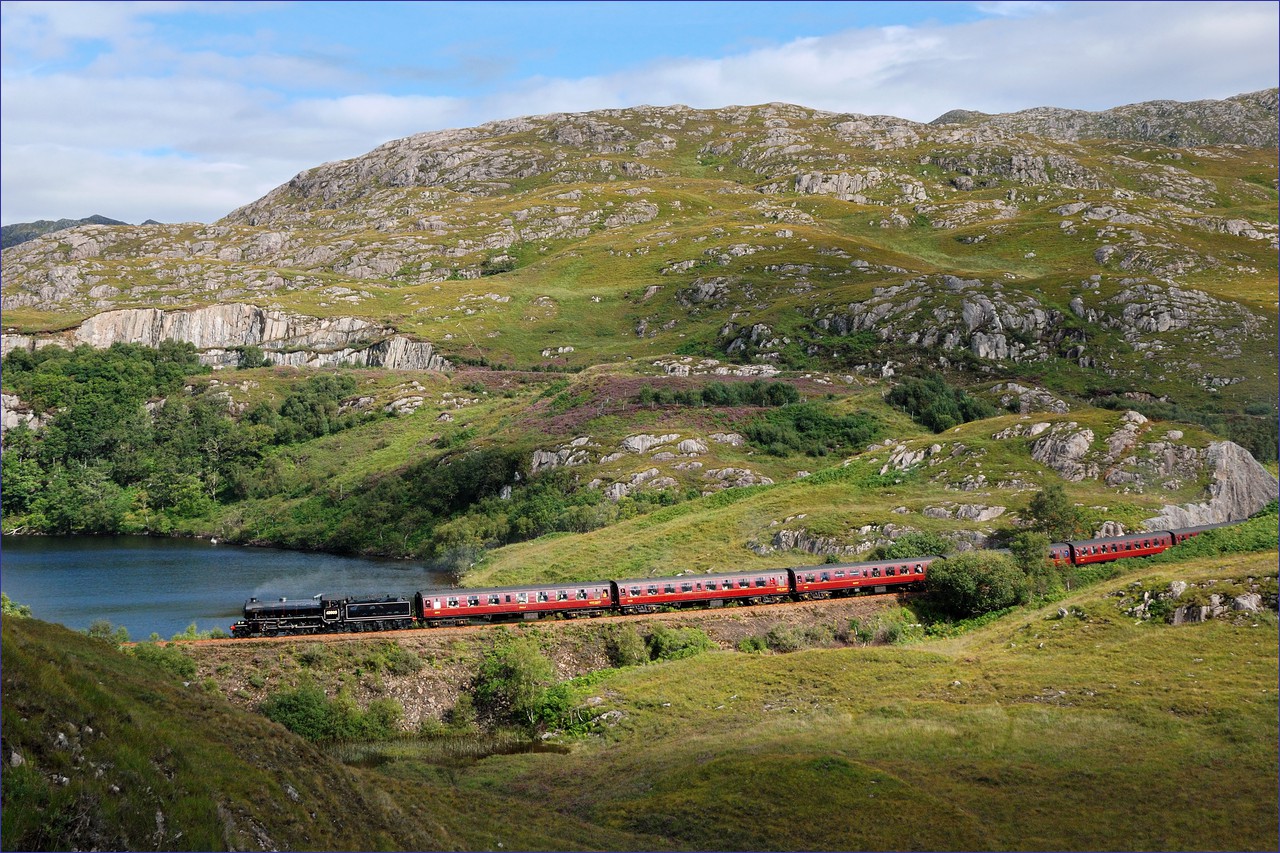
The railway in Scotland connects the most important cities and numerous towns. Train tickets are relatively inexpensive. Passenger trains in Scotland are operated by Scotrail. There are also several heritage railways operating in Scotland – some of them are world-famous. Train travel in Scotland is an adventure – stunning landscapes, lakes, castles and moors, friendly atmosphere. Don’t miss the Glenfinnan Viaduct on the scenic West Highland Line (Fort William – Mallaig).
Last updated: 13.09.2026
Table of contest:
1. Regular passenger services
2. The best offers
3. Heritage railways
4. Museum of Scottish Railways in Bo’ness
5. Funicular railways in Scotland
6. Scenic railways
7. What to see
8. Interesting facts about railway in Scotland
You can support this project by one-time small donation
Train travel in Scotland – regular passenger services
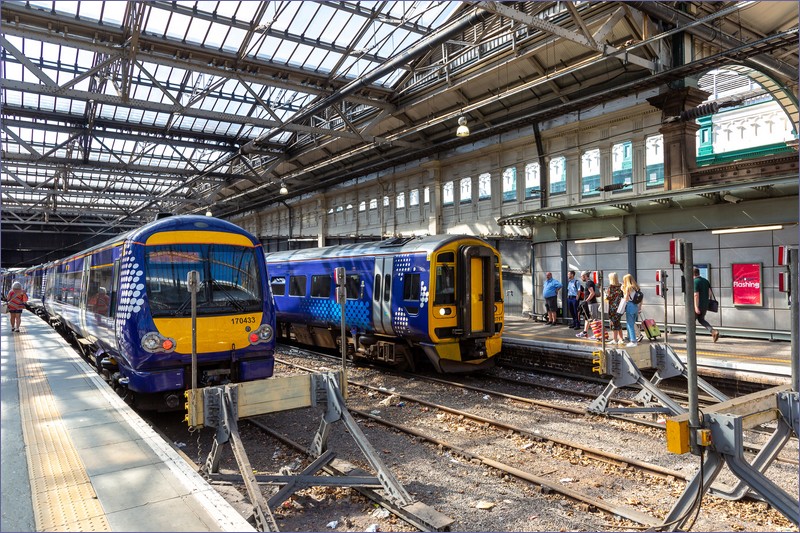
Regular rail passenger services throghout Scotland are operated by Scotrail. The company runs trains between Scotland’s largest cities. The rolling stock is typical for most regional British railway operators – the diesel multiple units don’t look very nice.
Scotrail offers several tickets for an inexpensive travel by train around Scotland. These tickets do not need to be purchased in advance before arriving in Scotland. Promotional tickets and passes are inexpensive, making train travel in Scotland relatively cheap.
Useful websites:
Scotrail – official website, search engine, additional information.
National Rail – search engine and e-shop for trains between Scotland and England.
Most popular routes:
Edinburgh – Glasgow
Edinburgh – Aberdeen
Edinburgh – Inverness
Glasgow – Mallaig (through Glenfinnan Viaduct)
Glasgow – Ayr
Glasgow – Kilmarnock
Glasgow – Inverness
Train travel in Scotland – the best offers
Spirit of Scotland – a travel pass that allows to make an unlimited number of journeys on Scotrail trains, selected ferries and selected buses for the duration of the ticket validity. Two types of ticket are available: valid for 4 selected days within a period of 8 consecutive days and valid for 8 consecutive days. The ticket entitles you to a 20% discount on a ferry trip to the Shetland and Orkney Islands.
Central Scotland Rover – a ticket allowing you to make an unlimited number of off-peak journeys between Glasgow and Edinburgh on 3 consecutive days. You can use this ticket on the Glasgow SPT Subway.
Highland Rover – a travel pass allowing to travel in the Scottish Highlands on four selected days over a period of eight consecutive days. Valid mainly on railway lines north of Glasgow and Aberdeen. It is also valid on selected ferries.
Scottish Grand Tour – a travel pass allowing you to travel on the entire Scotrail network, but only during off-peak hours and in one direction – clockwise or anti clockwise. Therefore, it is not useful if you have a starting point, for example in Aberdeen, and after a one-day trip you intend to return there for an overnight stay. With a Scottish Grand Tour ticket you can travel on 4 selected days within 8 consecutive days from the first day of your trip.
Rail & Sail – combined train and ferry ticket. Available to Shetland, Orkney, Outer Hebrides and Belfast.
Scotrail – additional information, prices, conditions.
In addition, several other operators are launching long-distance trains from Scotland to England.
Train travel in Scotland – heritage railways
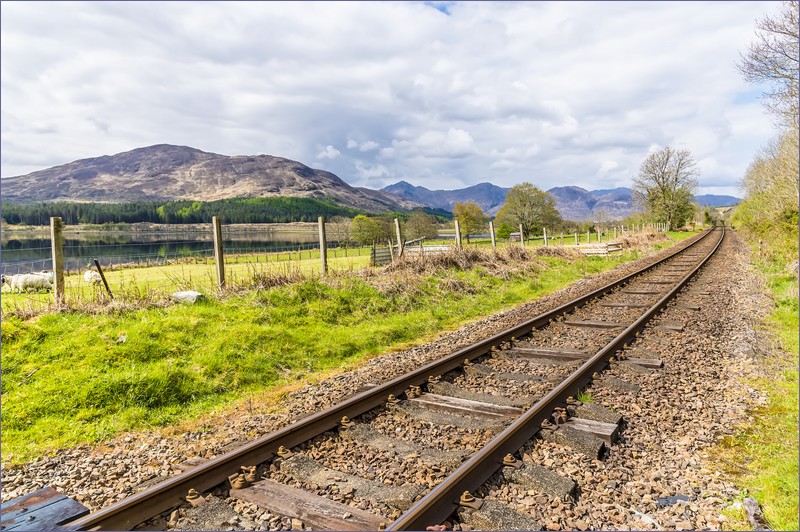
The list of the most important tourist railways (standard gauge and narrow gauge) in Scotland. Due to the very large number of active railways, the list does not include miniature railways running on very short routes and railway museums (I will write a separate article about these railway). The list is not complete. The data comes from the official websites. Ticket prices may vary on days when the railway is opened for certain events, festivals, etc.
Alford Valley Railway – the first narrow gauge passenger railway in Scotland with a gauge of 610 mm (according to the official website). It runs on weekends from the end of March to the third weekend of September from Alford station, through the golf course, to Haughton Park station on a route of approximately 1,400 meters. Trains depart every 40 minutes. In July and August, trains run every day.
Bo’ness & Kinneil Railway – vintage train rides along the eight-kilometer route from Bo’ness to Manuel. Trains run on weekends and selected days from the end of March to the end of October and in December. In July and August, the railway is open almost every day. The one-way journey takes 25 minutes. The nearest ScotRail station is Linlithgow, from where there is a bus service to Bo’ness.
Caledonian Railway – a popular tourist railway from Brechin to Bridge of Dun (6.4km). Usually trains run every weekend in June, July and November and on selected days. On Saturdays, trains are hauled by a diesel engine run, and on Sundays, by a steam locomotive. The line was closed to passenger traffic in 1952 and to freight traffic in 1981.
Jacobite Steam Train – a famous and very popular excursion train composed of a steam locomotive and vintage carriage. It runs on the line with regular passenger services from Fort William to Mallaig (66 km). It is one of the most beautiful railway lines in Great Britain – along the way the train passes mountains, rivers, picturesque villages. There are photo stops along the way.
Keith and Dufftown Railway – rides on old diesel multiple units between the Keith and Dufftown. Keith station is about 1200 meters from ScotRail station. The length of the railway route is approximately 16 kilometers. The one-way journey takes 48 minutes, with a stop at Drummuir. Trains usually run on Saturdays and Sundays from April to the end of September. Britain’s most northerly heritage railway.
Leadhills & Wanlockhead Railway – narrow gauge railway from Leadhills to Glengonnar. Trains run on weekends from April to the last weekend in September. The route is approximately 1,100 meters long. Located in the hills. Rides may sometimes be canceled due to weather conditions.
Royal Deeside Railway – a vintage train rides on a very short route along the River Dee at Milton of Crathes. The length of the line is approximately 1,400 meters and the return journey takes 15-20 minutes. The trains run mainly on weekends.
Strathspey Steam Railway – steam train rides from Aviemore to Broomhill (approx. 15.5 km). The railway runs on selected days from March to the end of October and on selected days in winter season, usually 3-4 times a week, in July and August, trips run every day. The one-way journey takes 45 minutes.
Related articles:
Train travel in Great Britain
The best heritage railways in England
The best narrow gauge railways in England
The best scenic railways in England
Museum of Scottish Railways in Bo’ness
The Museum of Scottish Railways is located in Bo’ness, Falkirk area, Scotland, next to Bo’ness Station on the heritage Bo’ness and Kinneil Railway. It is operated by the Scottish Railway Preservation Society (SRPS). It was established in 1995 and has become the largest railway museum in Scotland. It preserves the history of Scottish railways, including locomotives, rolling stock, railway equipment and archives. The museum offers interactive displays, including opportunities to explore railway technology, operate signalling equipment and learn about the daily work of railway employees.
The museum houses one of the most important collections of Scottish railway artefacts. The core collection has been recognised as being of national significance. Visitors can see steam and diesel locomotives, passenger carriages, sleeping coaches, freight wagons, railway signalling equipment, station equipment, photographs, documents and smaller railway objects. Most important steam locomotives are North British Railway G Class No. 42 (1887), North British Railway Class C No. 673 “Maude” (1891) and industrial locomotive “Fair Maid of Foyer”. One of the attractions is a preserved early Glasgow Subway carriage, showing the history of one of the world’s oldest underground railways.
A visit to the museum can be combined with a ride on the heritage railway, which operates steam and diesel trains along the restored line beside the Firth of Forth.
The museum is located close to Bo’ness Harbour, the Bo’ness and Kinneil Railway, and attractions of the Falkirk area, including the Falkirk Wheel and The Kelpies.
Museum of Scottish Railways – official website
Funicular railways in Scotland
There is an only one operating funicular in Scotland
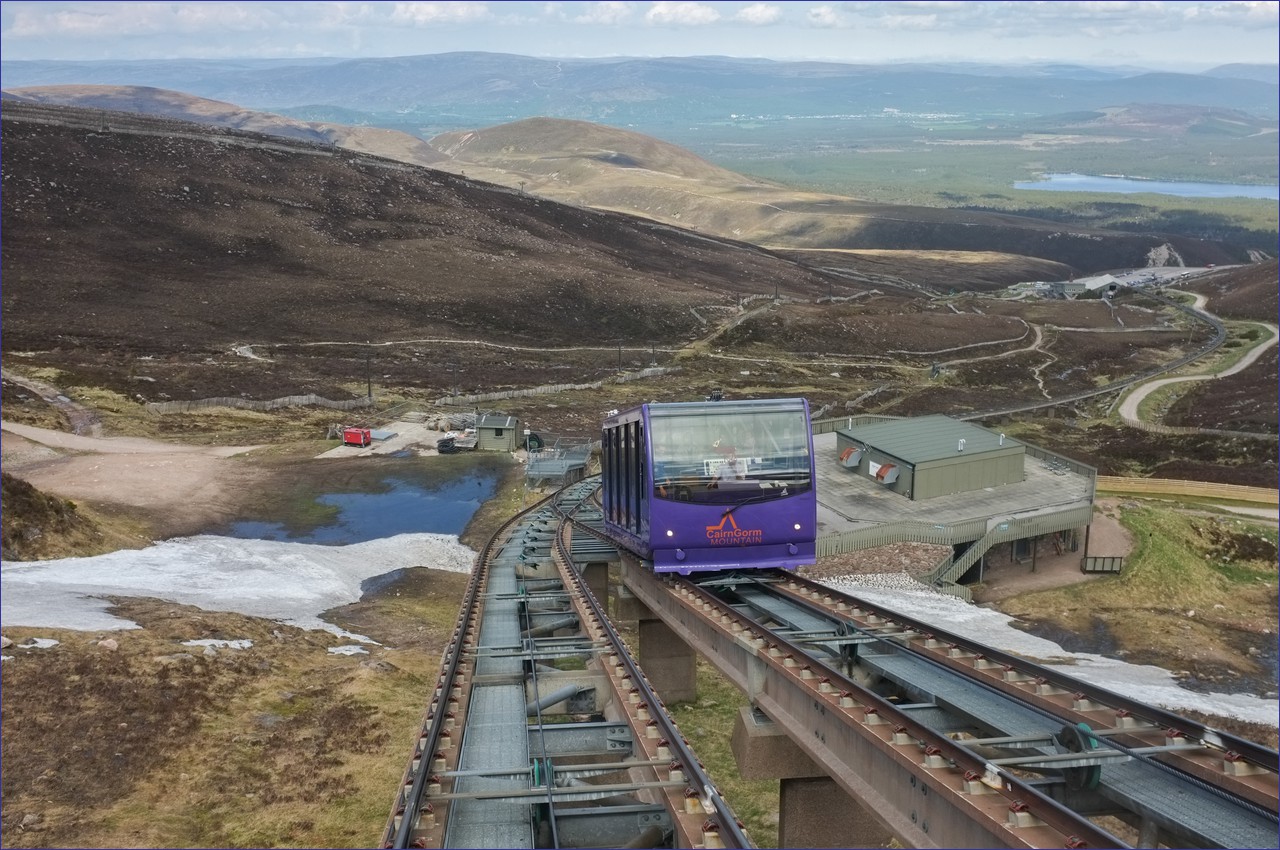
Cairngorm Mountain Railway – a funicular located on Cairn Gorm mountain near Aviemore in the Scottish Highlands. It serves the Cairngorm Mountain ski and outdoor recreation area within Cairngorms National Park. It is a funicular railway, where two carriages are connected by a cable and balance each other while travelling up and down the steep mountain slope. The railway opened in 2001, replacing an older chairlift system that had been affected by harsh mountain weather and strong winds.
The Cairngorm Mountain Railway is the highest railway in the UK. It climbs from the Base Station at about 635 metres above sea level to the Ptarmigan Top Station at 1,097 metres.
The funicular is approximately 1.97 kilometres long. Most of the route is carried on an elevated viaduct, with a short tunnel section near the summit.
It has single track with a central passing loop. Rolling stock consists two large passenger carriages designed and built by Doppelmayr, a specialist in cable transport systems. The maximum speed around 36 km/h.
The railway has three stations: Base Station – at the ski centre and car park, Shieling (Mid Station) – the passing point on the mountain and Ptarmigan Top Station – the upper terminal near the summit area.
During the short journey, passengers can enjoy views over the Cairngorm Mountains, Loch Morlich, the Glenmore Forest Park and the surrounding Highland landscape.
Scenic railways in Scotland
Train travel in Scotland features scenic railways alongside rugged mountains, picturesque meadows, rivers and lakes. There are most important of them.
West Highland Line – one of the most spectacular railway routes in Scotland, connecting Glasgow with the remote western Highlands and the ports of Oban and Mallaig. It passes through some of Britain’s wildest landscapes, including mountains, lochs, forests and moorland. The main route starts at Glasgow Queen Street station and runs through: Helensburgh, Rannoch, Fort William to Mallaig. At Crianlarich, the line divides into two branches: one to Oban and the other to Fort William and Mallaig. The route from Glasgow to Mallaig is about 164 miles (264 km), while including the Oban branch the total railway route is longer. Much of the line is single track with passing loops at selected stations.
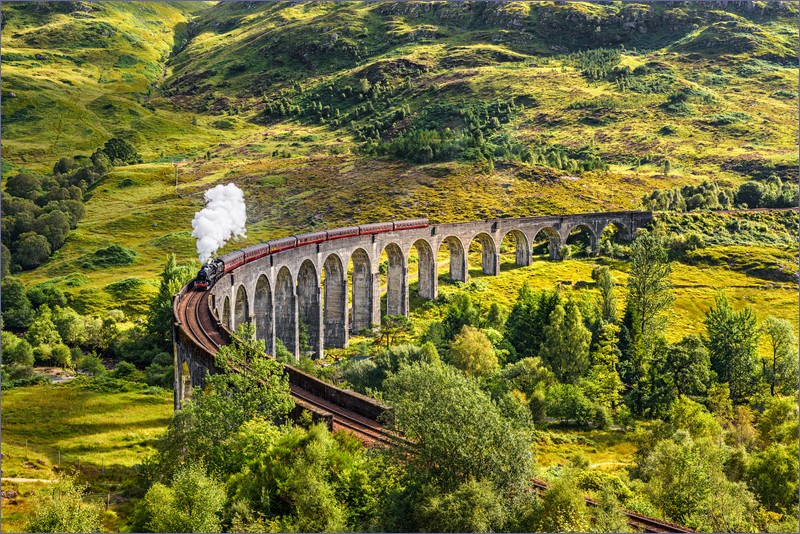
The most famous structure on the route is the Glenfinnan Viaduct, a curved concrete viaduct with 21 arches overlooking Loch Shiel. It became internationally famous after appearing in the Harry Potter films as part of the route of the Hogwarts Express.
The line is operated mainly by ScotRail passenger trains. The route is also served by the overnight Caledonian Sleeper between London and Fort William, allowing travellers to experience a Highland railway journey overnight. The Mallaig section is also famous for the seasonal Jacobite steam train, a heritage service that crosses the Glenfinnan Viaduct and attracts railway enthusiasts and Harry Potter fans from around the world.
Kyle Line – one of Scotland’s most scenic railway routes, running through the north-west Highlands from Inverness to Kyle of Lochalsh, a harbour village facing the Isle of Skye. It is operated by ScotRail. The line covers approximately 82 miles (132 km) and connects: Inverness, Dingwall, Achnasheen, Plockton, and Kyle of Lochalsh. The line was built to improve transport links in the remote Highlands and provide access to the west coast and ferry routes. It crosses remote Highland landscapes with mountains, lochs, forests and coastal scenery, offering views that are difficult to experience from roads. The final part of the journey follows the shores of Loch Carron, with views of rugged hills, sea inlets and the mountains of the western Highlands. Between Inverness and Kyle, the railway crosses some of the most sparsely populated areas of Scotland, including the remote Strath Bran and Strath Carron valleys.
ScotRail operates regular passenger trains between Inverness and Kyle of Lochalsh. The complete journey takes around 2 hours 40 minutes, making it suitable both as a day trip and as part of a Highland exploration itinerary.
Highland Main Line – one of Scotland’s most important scenic railway routes, connecting Perth in central Scotland with Inverness in the Scottish Highlands. It crosses the heart of the Highlands through dramatic mountain landscapes, valleys and remote countryside. The line runs for approximately 190 km (118 miles) between Perth and Inverness, with major stations including Pitlochry, Aviemore and Carrbridge. It passes through the Cairngorms National Park, offering views of mountains, forests, rivers and traditional Highland landscapes. One of the most impressive sections is the crossing of Drumochter Pass, where the railway climbs to its highest point at around 452 metres above sea level. The line passes between the Grampian Mountains and follows a route shaped by difficult Highland terrain. It features numerous Bridges and viaducts, long gradients through mountain passes, tunnels and cuttings.
The Aviemore station is connected with the heritage Strathspey Railway, which operates steam and diesel trains through the surrounding countryside.
The line is operated mainly by ScotRail passenger trains. It also carries long-distance services operated by the Caledonian Sleeper, connecting London with Inverness. A complete Perth–Inverness journey usually takes around 2 hours 20 minutes to 2 hours 40 minutes, depending on the service.
Far North Line – the most northerly railway line in mainland Britain. It runs through the remote landscapes of the Scottish Highlands, connecting Inverness with Wick and Thurso in the far north of Scotland. The line covers approximately 268 km (167 miles) from Inverness to Wick, with a branch line from Georgemas Junction to Thurso. The Far North Line is famous for its remoteness. It crosses large areas of empty countryside, peatlands and moorland, with long distances between settlements and some of the least-used stations in Britain.
The journey offers views of: the Moray Firth coastline, the Dornoch Firth, the Flow Country peatlands, Highland mountains, lochs, rivers and coastal scenery.
Passenger services are operated by ScotRail. Trains usually run between Inverness and Wick/Thurso, with the full journey taking around 4 hours.
The East Coast Line (the Scottish section) – one of Scotland’s most important railway routes. It runs along the east coast, connecting Edinburgh with Dundee and Aberdeen, passing through coastal landscapes, historic towns and major Scottish cities. The line is famous for its oastal section. The line offers views of the North Sea coastline, sandy beaches and cliffs, fishing villages, farmland and hills of eastern Scotland. One of the greatest railway landmarks on the route is the Forth Bridge, a UNESCO World Heritage Site. Opened in 1890, this massive cantilever bridge over the Firth of Forth remains one of the world’s most famous railway structures.
Passenger services on the Scottish section are operated mainly by ScotRail regional trains between Edinburgh, Dundee and Aberdeen and long-distance services connecting Scotland with England, including London King’s Cross.
Train travel in Scotland – What to see:
Scotland has many interesting places. There are most important towns and cities for tourists who want to visit this country for the first time.
Edinburgh – the capital of Scotland and one of the United Kingdom’s most historic and culturally important cities. It is located on the southern shore of the Firth of Forth, between hills and the North Sea coast. Edinburgh’s historic centre is recognised as a UNESCO World Heritage Site. The city is famous for the contrast between the medieval Old Town and the elegant Georgian New Town built from the 18th century. Main attractions include Edinburgh Castlecstanding dramatically on top of an extinct volcanic rock, Royal Mile – the historic main street of Edinburgh’s Old Town, Palace of Holyroodhouse – the official Scottish residence of the British monarch. Scottish National Museum, National Gallery of Scotland, shopping street Princes Street Calton Hill – one of Edinburgh’s easiest viewpoints, a picturesque former milling village near the city centre named Dean Village.
Arbroath – a coastal town on the North Sea coast of Angus, between Dundee and Montrose. The city is famous for Arbroath smokie, a traditional smoked haddock speciality and Arbroath Abbey, famous as the place where the Declaration of Arbroath was issued in 1320. Visitors can explore the impressive red sandstone ruins, the church remains, the visitor centre with historical exhibitions. Near the town lies picturesque cliffs with rock formations and sea caves. Walking trails provide views over the North Sea and Angus coastline.
Elgin – a small town in Moray, north-east Scotland. It lies between Inverness and Aberdeen, near the coast of the Moray Firth. Elgin is the administrative centre and largest town of the Moray region. Tourists can visit medieval ruins of the Elgin Cathedral The cathedral was damaged during the Scottish Reformation in the 16th century but remains a spectacular monument.
Visitors can climb the tower for views over Elgin and the surrounding countryside. The Elgin Museum, founded in 1843, it is one of the oldest independent museums in Scotland. Exhibits cover the history of Moray from prehistoric times to the modern era. A few kilometres north of Elgin is located Spynie Palace former residence of the Bishops of Moray for more than 500 years and Spynie Distillery – one of the most famous distilleries in Scotland.
Inverness – the largest city and administrative centre of the Scottish Highlands. It is located where the River Ness flows into the Moray Firth, at the northern end of the Great Glen. It is often called the “Capital of the Highlands” because it is the main cultural, commercial and transport centre of northern Scotland. Inverness is a gateway to many famous Highland destinations, including: Loch Ness, the Isle of Skye, the Cairngorm Mountains, remote Highland villages and landscapes. Most recognisable landmark is the Inverness Castle. There are walking paths, gardens and historic Bridges along the River Ness which runs through the centre of the city and connects Loch Ness with the Moray Firth. Noteworthy is also the Inverness Cathedral built in the 19th century from red sandstone. Tourists can visit also Inverness Museum and Art Gallery. Near Inverness are located ruins of the Urquhart Castle and Clava Cairns – a prehistoric cemetery complex dating back around 4,000 years.
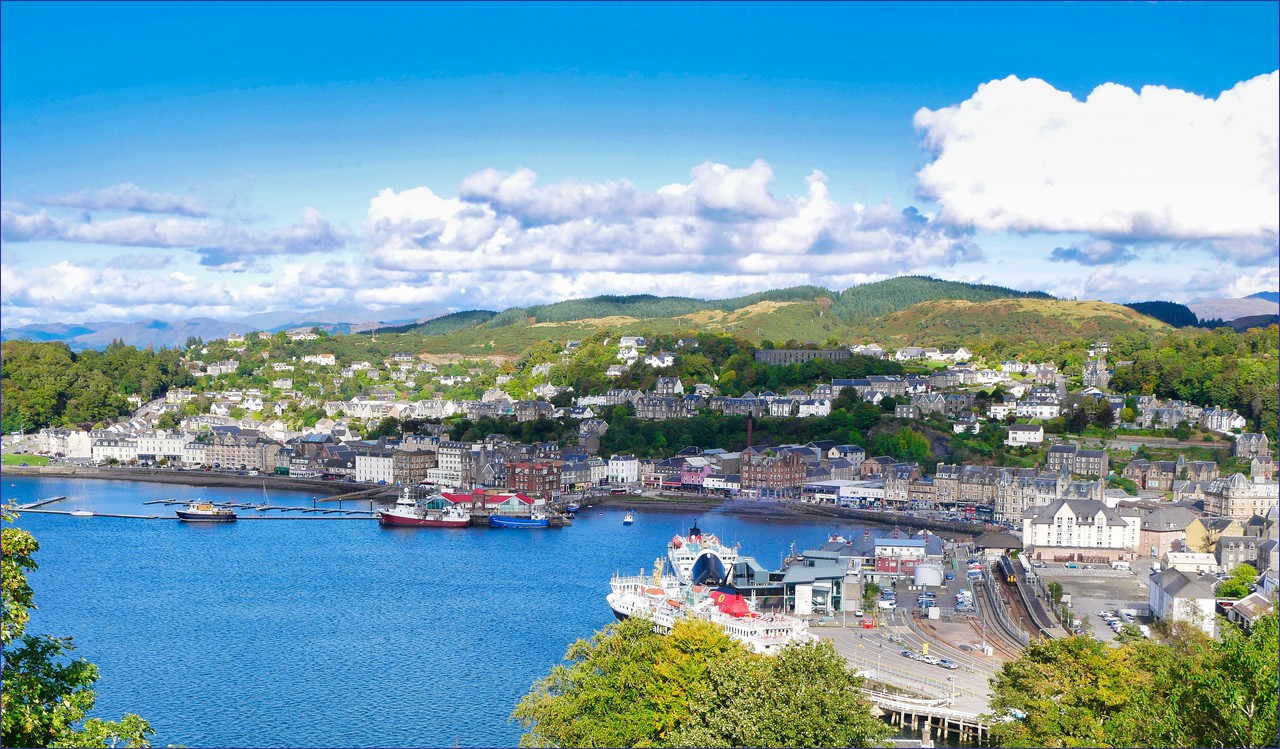
Oban – a picturesque coastal town on the west coast of Scotland, located on the shores of Oban Bay overlooking the islands of the Inner Hebrides. It is often called the “Gateway to the Isles” because of its ferry connections to several Scottish islands.Oban has around 8,000–9,000 inhabitants, but the town becomes much busier during the tourist season due to visitors travelling to the Highlands and islands. Main attractions include Main McCaig’s Tower inspired by Roman architecture, especially the Colosseum, Oban Distillery founded in 1794, ruins of Dunollie Castle, St Columba’s Cathedral – a striking modern cathedral overlooking the bay, known for its beautiful stained glass and seaside setting.
Stirling – a historic city in central Scotland, located between the Scottish Highlands and Lowlands. It stands on the banks of the River Forth, around halfway between Edinburgh and Glasgow. The city has around 40,000 inhabitants and it’s most famous landmark is the Stirling Castle located on a dramatic volcanic hill. It’s one of Scotland’s greatest castles and former royal residences. Mary, Queen of Scots, was crowned here in 1543. The castle offers spectacular views over the surrounding countryside. A popular is also the National Wallace Monument – a 67-metre-high Victorian Gothic tower built in honour of Scottish hero William Wallace. Visitors can climb the tower. Stirling has a nice well-preserved Old Town with medieval streets and old merchant’s houses. Noteworthy is the Church of the Holy Rude, One of Scotland’s oldest churches still used for worship, founded in 1129.
Interesting facts about railways in Scotland
- The Corrour station is the highest railway station in Britain at around 408 metres above sea level. It has no public road access and can only be reached by train or on foot, making it one of the most remote stations in the UK.
- The station at Arisaig is the most westerly railway station on the British mainland. From the train, passengers can see spectacular views towards the islands of Rum, Eigg and Skye.
- The Highland Main Line includes the highest point on the UK main railway network, near Druimuachdar Summit between Dalwhinnie and Blair Atholl.
- Altnabreac station is one of the most isolated railway stations in Britain, Altnabreac has no public road access and is surrounded by forests, lochs and wilderness. It is a popular destination for railway enthusiasts seeking unusual stations.-
- The Dunrobin Castle located about 1.5 km north of Golspie in Sutherland has its own railway station. The station is open for passengers only from April to October when the castle is open for visitors.
- Many of the closed Scottish railway lines were dismantled and converted into walking trails. Most famous include Glen Ogle Trail, Dava Way and Deeside Way.
- In Edinburgh you can walk through The Innocent Railway Path in Edinburgh. It is a popular, traffic-free pedestrian and cycle route that follows Scotland’s first railway line, which originally opened in 1831 as a horse-drawn tramway. The long of the path is about 2.5 km.
- A very interesting monument is the the Leaderfoot Viaduct, also known as the Drygrange Viaduct, is a railway viaduct over the River Tweed near Melrose in the Scottish Borders. A portion of the 2023 film Indiana Jones and the Dial of Destiny was filmed at the viaduct, although the scene was said to be located in Switzerland.
- Isle of Skye has no railways but in the past there was an industrial Skye Marble Railway operating between 1910-1912. The line was 6 km long. Vistors can see remains of the former trackbed and a former platform of the railway.
- In 2015 the new railway line from Edinburgh to Tweedbank was opened. It was the UK’s longest new domestic line to open in the UK for over 100 years. In order to get the new line up and running, 42 new bridges were built, 95 were refurbished and seven new stations were created.
- In 2024 the Levenmouth Rail Link was opened. It allows to connect Edinburgh with Cameron Bridge and Leven.
- The two closest stations on the network Culrain and Invershin are just one minute ride apart. But the walk between them lasts about 15 minutes. It’s possible thanks to the Shin Viaduct, which carries the railway over the Kyle of Sutherland. One station is on one side of the water, the other on the opposite side. The footpath alongside the line connects the two banks which makes it as quick to walk, as it is to drive.