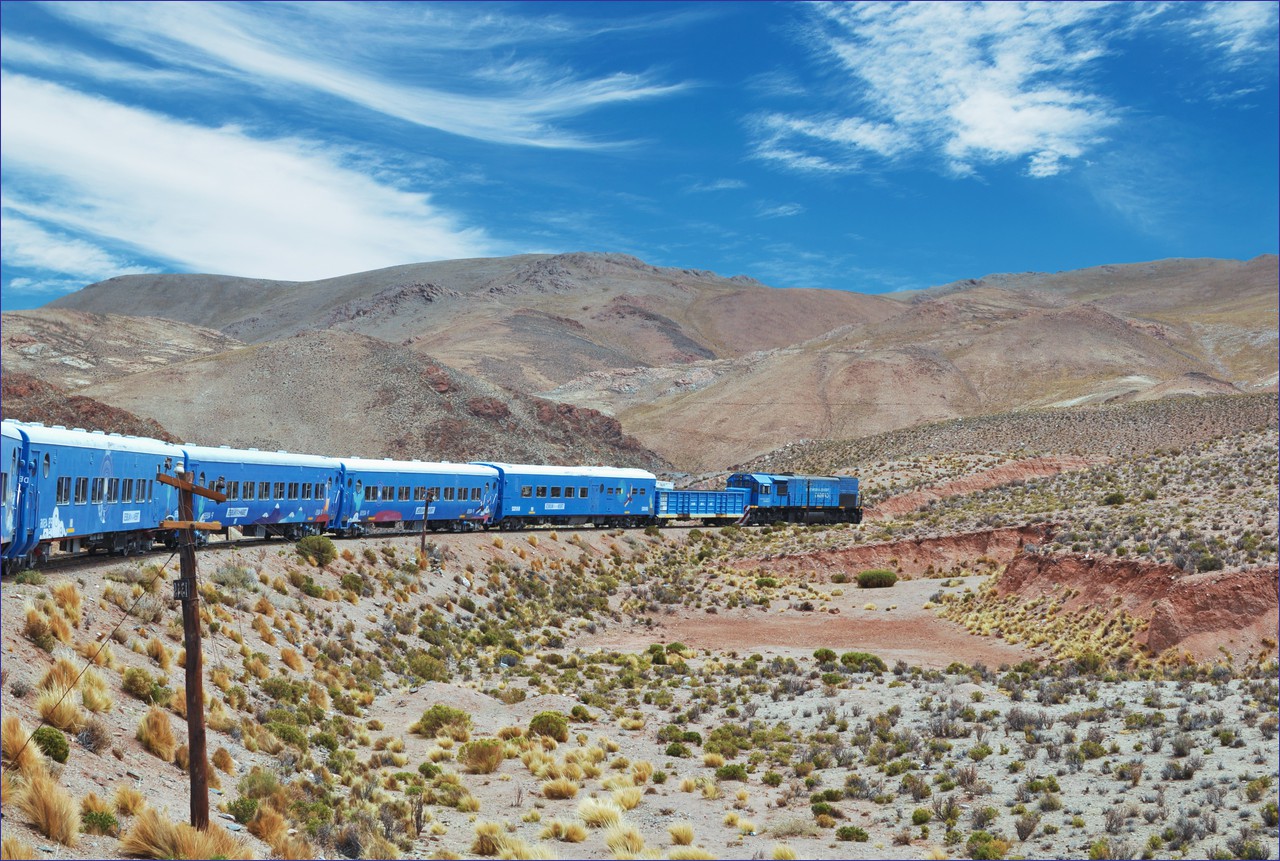
Argentina has an extensive railway network but it is primarily used for freight transport. Train travel in Argentina is limited to only a few long-distance trains, suburban trains in Buenos Aires and some regional passenger services. There are also tourist trains in Argentina, some of them are world-famous.
In recent years, the number of long-distance trains has significantly improved. The old passenger cars have been replaced with new ones manufactured in China. People are eager to use trains.
Most of passenger trains in Argentina are operated by government-owned Trenes Argentinos.
Last updates: 25.09.2026
You can support this project by one-time small donation
Train travel in Argentina – useful websites:
Trenes Argentinos – official website. Timetable, prices and tickets.
SOFSE – online shop for some trains.
Tren Patagonico – long-distance train from Viedma to Bariloche.
Tren a las Nubes – a very popular tourist train in Salta.
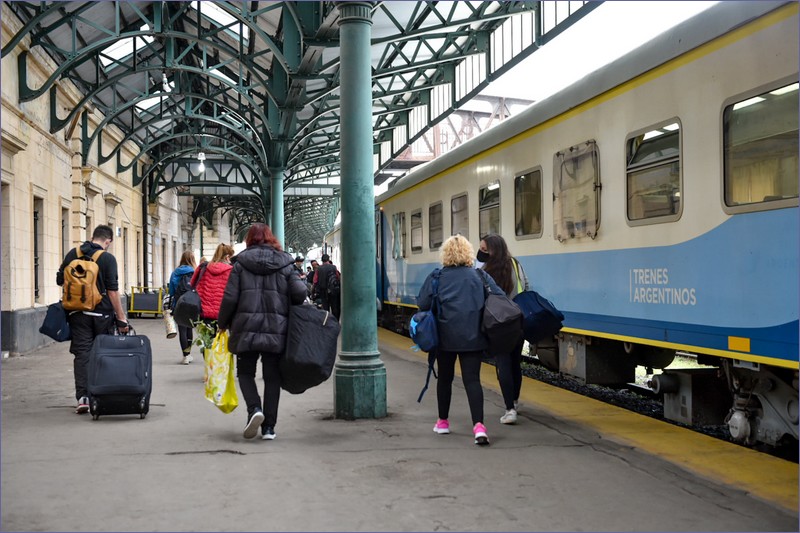
Long-distance trains in Argentina
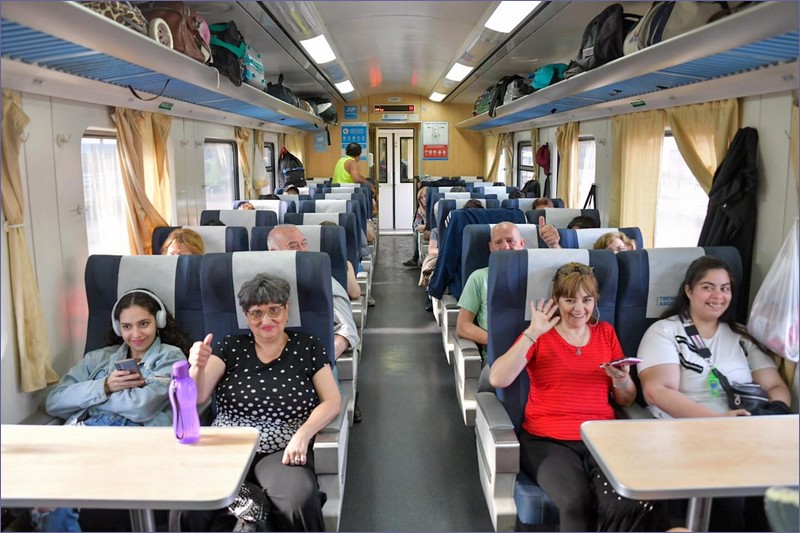
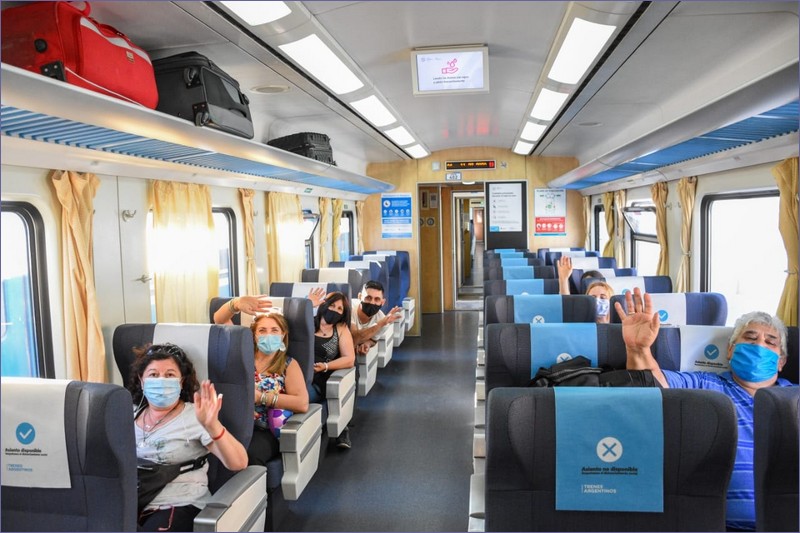
Long-distance trains in Argentina connect largest city in the country. Trains are comprised of Chinese-made passenger carriages equipped with air-conditioning and vacuum toilets. Passengers can choose between 2nd class, 1st class, in some trains restaurant car and sleeping carriages are also available.
Seat reservation is compulsory.
Long-distance trains run on the following routes:
Buenos Aires – Mar del Plata
Buenos Aires – Rosario
Buenos Aires – Córdoba
Buenos Aires – Tucumán
Train from Buenos Aires – Bahía Blanca is currently suspended but it may change in the future. Trains are periodically canceled, then reinstated, and so it goes on in a cycle.
My favourite long-distance train in Argentina was “The Gran Capitan” from Buenos Aires to Parana. The route of the train led along border with Uruguay and Brazil and train terminated in Parana on the border with Paraguay. The train was discontinued but in my opinion it has an huge tourist potential and I don’t understand, why Argentinian authorities don’t reinstate it.
There are no long-distance trains to Parana at all.
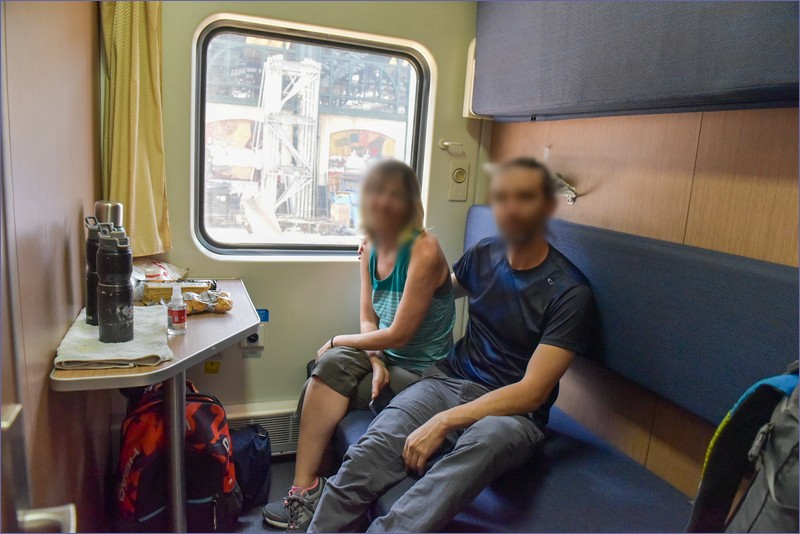
Tren Patagónico
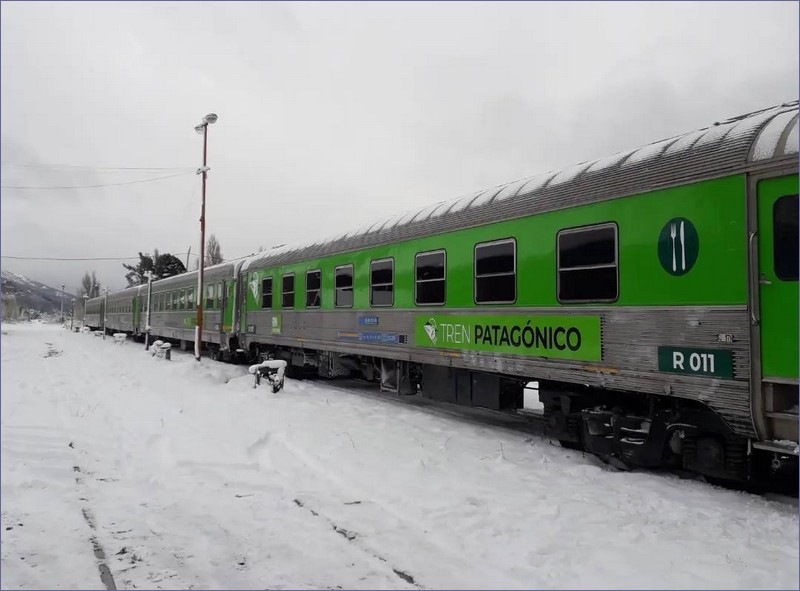
Tren Patagonico is a train operator in Patagonia. The operator run the following trains:
Long-distance train Viedma – Bariloche
Regional train Bariloche – San Antonio Oeste
Regional train Ing. Jacobacci – Bariloche
Seasonal tourist train La Trochita (Old Patagonian Train)
Most famous is a long-distance train from Viedma to Bariloche which is situated not far away from the Chilean border. This train is comprised of seating carriages, sleeping carriage, restaurant carriage and carriages intended for transport of the cars and motorcycles.
Regional trains are served by Chinese diesel multiple units equipped with air-conditioning. Seats are comfortable.
Tourist train La Trochita is a steam-hauled train with vintage carriages with wooden seats.
Tren Patagónico – official website
Train travel in Argentina – international trains
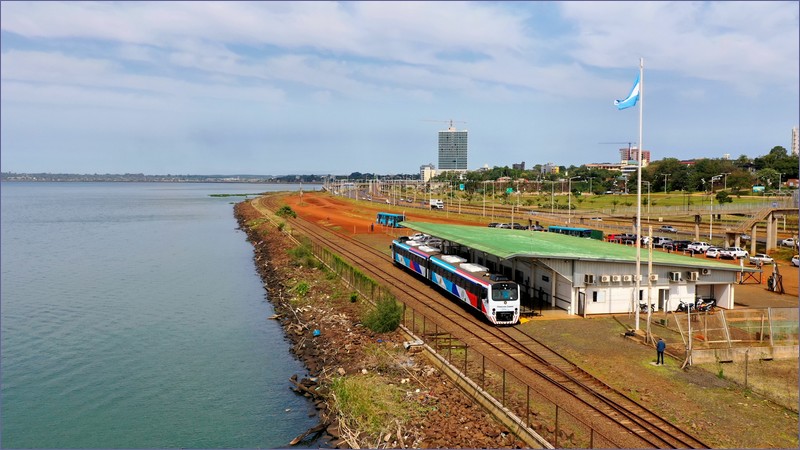
Argentina has a railway links with adjacent countries but only international passenger trains is cross-border train from Parana to Entroncamento in Paraguay. There are many trains daily. Journey time is about 5 minutes and advanced reservation is no needed.
On 30 August 2011 train from Argentina to Urugay was inaugurated. Train ran from Pilar, Argentina to Paso de los Toros, Urugay (813 km) through Salto and Paysandu (2nd a 3rd largest cities in Urugay). The service was stopped in 2012. There were plans to launch a new passenger train between Argentina and Uruguay in 2023 but failed.
Tren de las Sierras
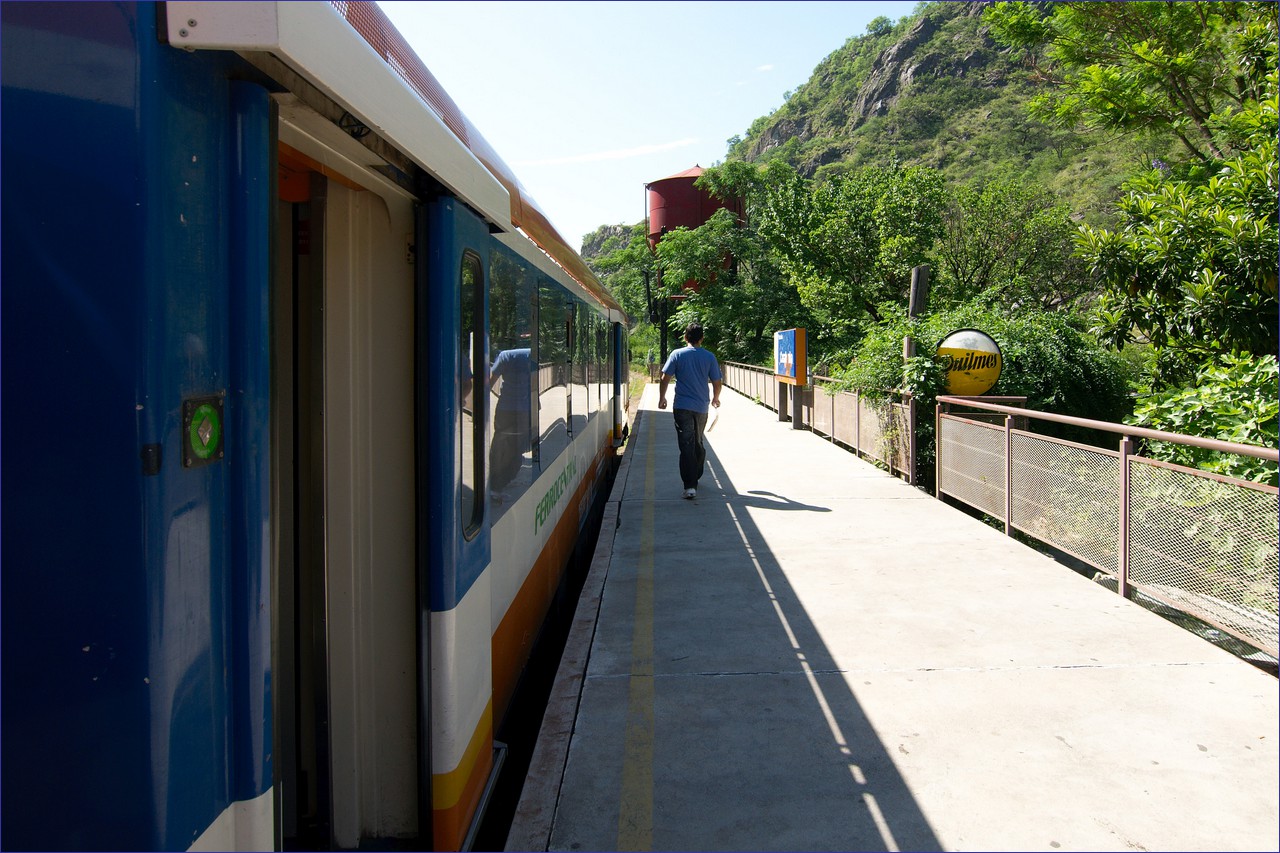
Tren de las Sierras – a regional passenger railway in Córdoba Province, Argentina, operated by the state railway company Trenes Argentinos. It runs through the scenic Punilla Valley, connecting Córdoba with Capilla del Monte. The route is part of a much older railway connection that historically linked Córdoba with Cruz del Eje.
The present service was extended progressively northwards and has reached Capilla del Monte since 2023. The complete railway route is considerably longer than the currently advertised tourist journey, while the Córdoba–Capilla service covers roughly 100 km according to Argentine tourism information.
The line passes through numerous towns and stations, including La Calera, Casa Bamba, San Roque, Bialet Massé, Santa María de Punilla, Cosquín, Valle Hermoso, La Falda, Huerta Grande, La Cumbre, San Esteban and Capilla del Monte. Cosquín is one of the best-known intermediate destinations. The town is famous throughout Argentina for the Cosquín National Folklore Festival, making the railway useful for visitors interested in both railway travel and regional culture.
The most scenic section is generally considered the route through the Punilla Valley, where the railway passes between hills and mountains and follows valleys and waterways. Argentina’s tourism authority specifically highlights the landscapes, rivers, ravines and vegetation visible from the train.
The section between Córdoba and La Calera functions as an interurban/regional commuter service, while the railway farther north towards Capilla del Monte has a much stronger tourist character. The journey from Córdoba to Capilla del Monte takes around five hours, making the train considerably slower than the road connection.
The train runs daily. Some trains still operate only on shorter sections, so passengers should check the current timetable rather than assuming that every train covers the entire route.
The rolling stock used on the line includes diesel multiple units, including Materfer/Emepa Alerce and Alstom railcars. These are quite different from the steam locomotives and historic coaches found on Argentina’s dedicated tourist railways.
The service has experienced temporary disruptions and timetable changes. Checking the current information from Trenes Argentinos before travelling is particularly important.
Miniature railways in Argentina
Tren Histórico del Parque Avellaneda – a miniature railway also known as Expreso Alegría located in Parque Avellaneda, in the southwest of Buenos Aires. It is a narrow-gauge railway running entirely inside the park. The present circuit is about 1.6 km long, with a journey of approximately 15 minutes. The history of the train actually begins in the Buenos Aires Municipal Zoo. A small railway was built there in the early 20th century and began operating in 1909. he train’s route is particularly interesting because it passes through a historic public park created on the site of the former Olivera estate. Buenos Aires acquired the land in 1912 and the park was inaugurated in 1914.The railway suffered from years of poor mainten ance. Its operation was suspended in 1998, and several attempts were subsequently made to restore it. A first major reopening took place in 2006, but technical and infrastructure problems meant that the service did not operate normally for long. After another restoration, the train reopened on 29 August 2015. The track, station, signals and rolling stock were restored, and the city announced regular Saturday operation.
The train as operating on Saturdays but it is possible that service was suspended.
Train travel in Argentina – tourist trains
Tren a las Nubes – a famous tourist railway in Salta Province, northwestern Argentina, running through the high-altitude landscapes of the Puna. It is one of Argentina’s best-known railway attractions. The line was built to connect Salta with the Chilean border at Socompa, eventually providing a railway connection towards Antofagasta, Chile. The railway reaches approximately 4,200 metres above sea level at the spectacular Viaducto La Polvorilla, one of its best-known engineering structures. The viaduct is about 225 metres long and 67 metres above the ground, and is built on a curve. Instead of rack-and-pinion technology, the engineers used a combination of zigzags, loops, tunnels and viaducts to overcome the enormous difference in elevation. This is one of the most interesting features of the railway for railway enthusiasts. Today, the regularly advertised tourist train operates on the approximately 22-km section between San Antonio de los Cobres and the Viaducto La Polvorilla.
The train journey from San Antonio de los Cobres to La Polvorilla and back takes about 1½ hours in total, according to Argentina’s official tourism information. The spectacular scenery includes the Quebrada del Toro, barren Andean mountains, high-altitude plains, cardón cacti and other characteristic landscapes of the Puna. National Route 51 follows the railway through part of the valley, making it possible to see some of the railway’s engineering works from the road. The current operator is the state-owned Servicio Ferroviario Turístico Tren a las Nubes S.E., which is officially classified as a tourist passenger railway.
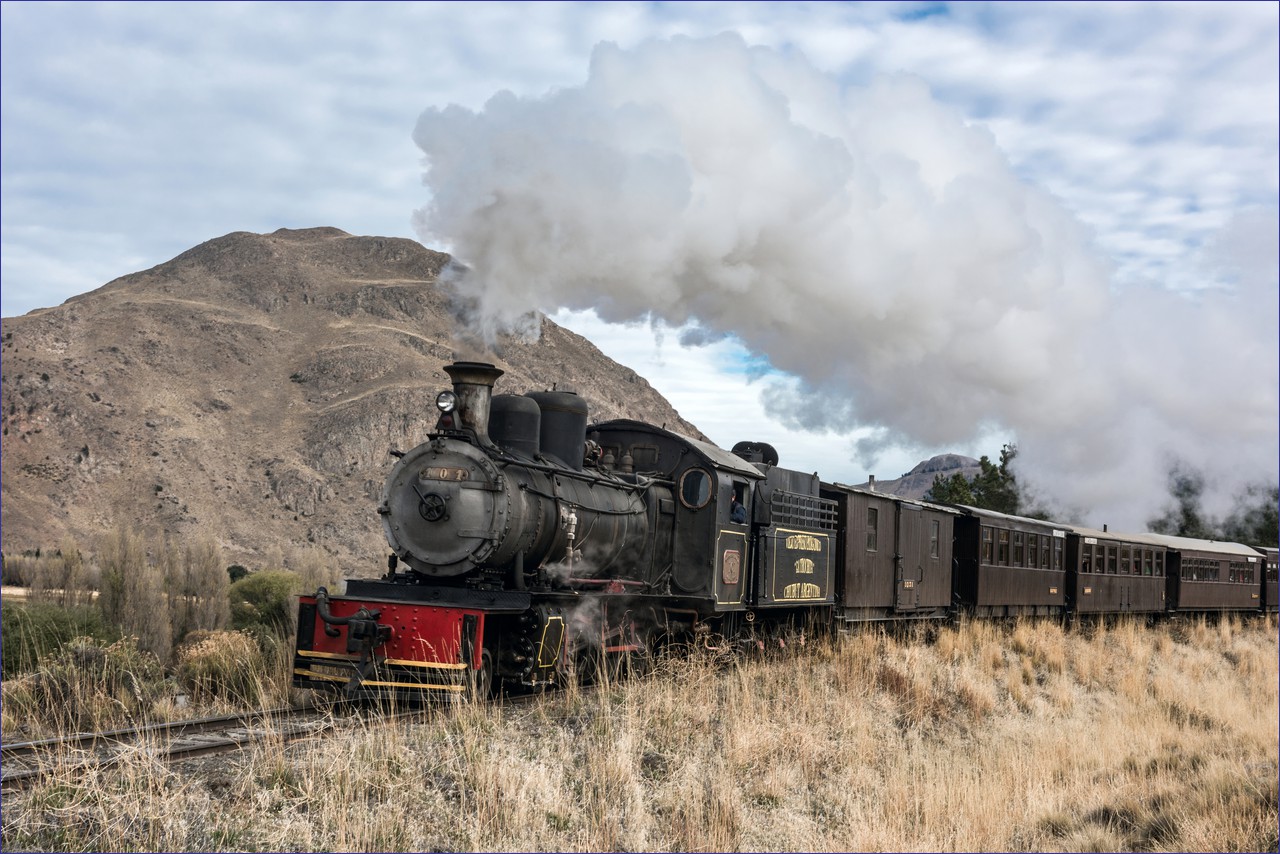
La Trochita – a tourist train officially Viejo Expreso Patagónico (Old Patagonian Express). It is a historic narrow-gauge railway in Patagonia, Argentina. The original railway was intended to form part of a much larger network connecting different parts of Patagonia. The surviving Ingeniero Jacobacci–Esquel section eventually became about 402 km long, with more than 600 curves. In its working days, La Trochita was an important means of transport for the remote settlements of Patagonia. It carried passengers, wool, grain, timber, animals and other freight, connecting the region with the wider Argentine railway network. The railway became particularly famous internationally after Paul Theroux wrote about it in his 1979 book The Old Patagonian Express. The English name “Old Patagonian Express” subsequently became widely associated with the train. The national government decided to close the railway in 1993 for economic reasons. The provinces of Chubut and Río Negro then took responsibility for sections of the line within their territories, allowing the historic railway to survive. The complete original route between Ingeniero Jacobacci and Esquel is no longer operated as a regular passenger service. Today, the main tourist operations are based around Esquel and El Maitén. From Esquel, the train currently operates to Nahuelpan, a journey of roughly 18–19 km. The official railway website gives a total excursion time of about three hours, including the stop at Nahuelpan.
La Trochita operates throughout the year, but the number and dates of departures vary considerably according to the season. The official operator recommends checking the timetable in advance and purchasing tickets ahead of time.
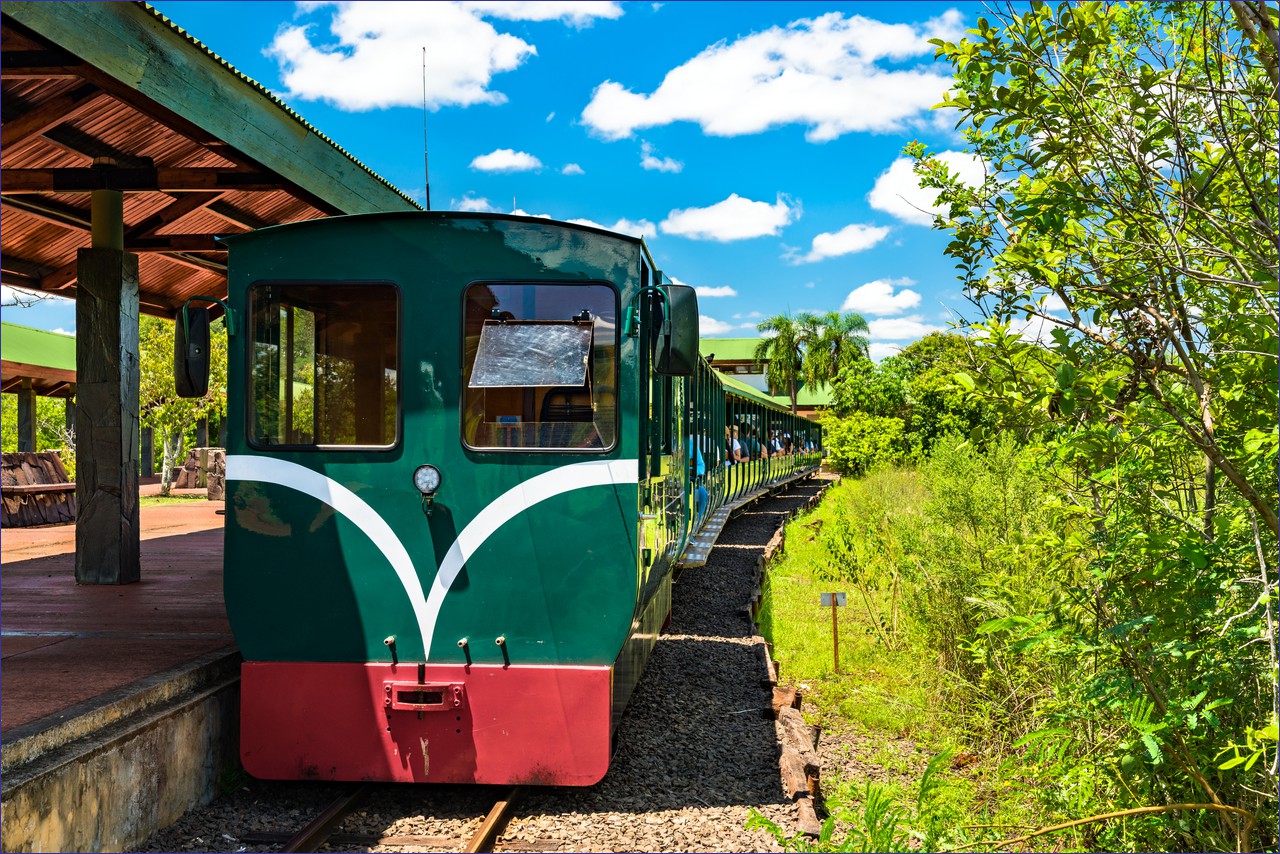
Tren Ecológico de la Selva – a tourist train operating inside Iguazú National Park in Misiones Province, northeastern Argentina. It provides access to the main walking circuits around Iguazú Falls. The railway connects three stations: Estación Central, Estación Cataratas and Estación Garganta. The trains use open-sided carriages, allowing passengers to experience the surrounding subtropical rainforest during the journey. The railway was specifically designed to have a relatively low impact on the protected environment. The locomotives have traditionally used electric or LPG (liquefied petroleum gas) propulsion.The service is included in the general entrance ticket to the Iguazú National Park, rather than requiring a separate railway fare. Visitors must obtain a free boarding ticket/turn at the designated ticket offices. Trains usually operate daily. Frequencies are normally around 30 minutes, with more frequent trains during periods of high demand.
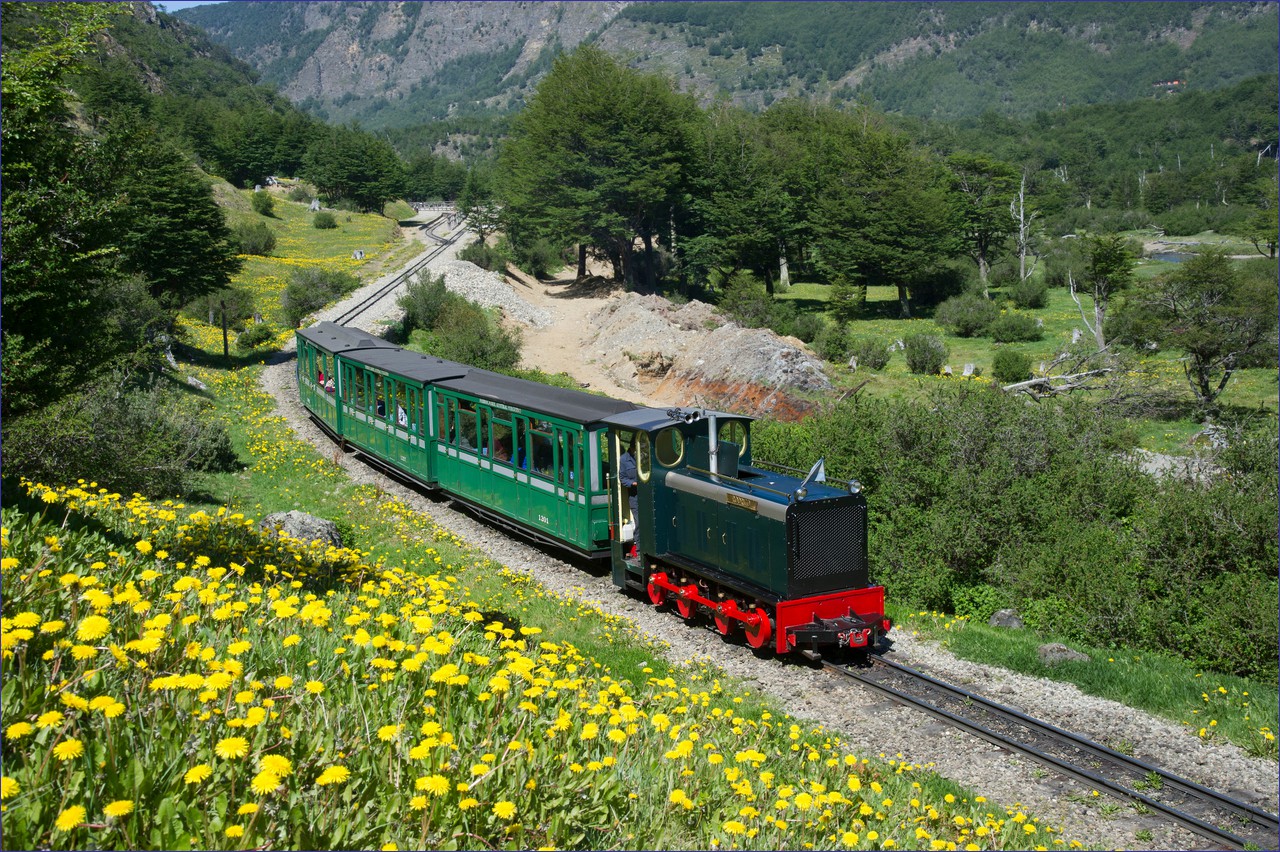
Tren del Fin del Mundo – a tourist train in Ushuaia, Tierra del Fuego, in southern Argentina. It operates on a short line between the outskirts of Ushuaia and Tierra del Fuego National Park. The present tourist railway follows part of the route of the former Ushuaia prison railway, popularly known as the Tren de los Presos (Prisoners’ Train). Prisoners were transported into the forest to cut firewood and perform other work. After the prison closed, the original railway disappeared from regular use. In 1993, the company Tranex Turismo proposed restoring part of the old alignment as a tourist railway. The surviving embankments and railway works made it possible to reuse much of the historical route. The modern tourist railway runs for approximately 7 km. The train starts at the Fin del Mundo Station, outside the national park, and enters Tierra del Fuego National Park during the journey. The journey follows the Pipo River valley and passes through Patagonian forests, peat bogs and mountain scenery. The route also includes the Macarena waterfall, where the train makes a stop.The train is frequently promoted as the world’s southernmost railway. The railway operates throughout the year, although departure schedules and the exact tourist programme vary by season.
Tren Histórico de Villa Elisa – a heritage railway in Villa Elisa, Entre Ríos Province, operated by the Ferroclub Central Entrerriano, a non-profit railway preservation organisation. The railway uses part of the former Entre Ríos Railway network, later incorporated into the General Urquiza Railway. The line is 1,435 mm standard gauge. Regular railway services were eventually discontinued, and the Caseros–San Salvador branch was closed in 1980. The Ferroclub Central Entrerriano was established in the 1990s and began restoring railway equipment and operating tourist excursions. The short excursions around Villa Elisa are an important part of the present tourist operation. The municipality also describes “zorra” rides on a small rail vehicle, covering about 4 km. Longer excursions have traditionally run from Villa Elisa through Primero de Mayo and Pronunciamiento to Caseros, covering the approximately 36-km historic route. One of the most attractive excursions is the journey to Palacio San José, the former residence of Justo José de Urquiza. Passengers travel by train to Caseros and then continue by road to the palace. The route passes through the rural landscape of Entre Ríos, with fields, farms and small settlements.
In September 2026 state that the historic train has returned to the 36-km route toward Palacio San José after a long absence.
Tren del Vino – a wine-tourism experience introduced in 2026 in Jujuy Province, northern Argentina. It combines a journey on the Tren Solar de la Quebrada with visits to wineries and vineyards in the Quebrada de Humahuaca. The first official Tren del Vino departure took place on 26 July 2026. The train runs from Volcán to Tilcara, following the scenic railway through the Quebrada de Humahuaca. The complete experience takes approximately six hours. It is operated using the Tren Solar de la Quebrada, described by the Jujuy government as the first train in Latin America powered by solar energy/battery technology.
The route passes through some of the most spectacular parts of the Quebrada de Humahuaca, a UNESCO World Heritage landscape. The railway journey is combined with wine tastings, visits to wineries, regional food and an introduction to Jujuy’s high-altitude wine production. A sommelier accompanies passengers throughout the experience. The first major stop is Tumbaya, where the programme includes tastings from Antropo Wines and Bodega El Molle. The journey ends at Tilcara, where passengers can visit the Tren Solar Wine Shop, displaying wines from producers throughout Jujuy.
The programme was initially announced with departures from July through November. Tren del Vino should not be confused with the proposed Tren del Vino in Mendoza. The Mendoza project was never put into regular operation, whereas the Jujuy Tren del Vino is an actual operating tourist experience launched in 2026.
Related articles:
Railways in Americas by country
Trenopedia – main site