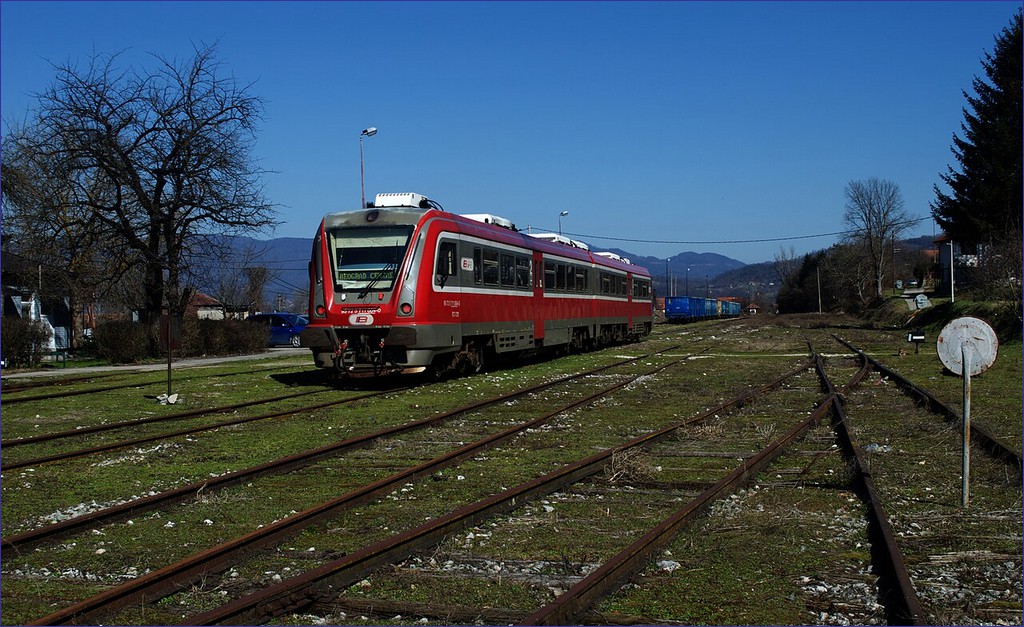
Train from Belgrade to Zvornik is a regional train from the capital of Serbia to the border station situated on the opposite bank of the Drina river. Despite the name of the end station (Zvornik) the train terminate in a village Mali Zvornik in Serbia. There is a border crossing between Serbia and Bosnia and Herzegovina, but currently there are no passenger trains from Zvornik to the Bosnian inland.
In the past, there were plans to reroute train from Belgrade to Sarajevo via Zvornik and Tuzla to bypass Croatian territory, but the train was eventually cancelled.
The connection may be shortened or cancelled in the future.
Useful websites:
Srbija Voz – timetable
Train travel in Serbia – a general overview
Most important towns and cities:
Belgrade – the capital and largest city of Serbia, situated at the confluence of the Sava and Danube rivers. The most famous historical landmark is Belgrade Fortress, surrounded by Kalemegdan Park. The site contains remains from Roman, Byzantine, medieval Serbian, Ottoman and Austro-Hungarian periods. Belgrade became the capital of modern Serbia in the 19th century and has remained the country’s political, economic and cultural centre. The monumental Church of Saint Sava is one of the largest Orthodox churches in the world. Knez Mihailova Street is the principal pedestrian and shopping street in the historic centre.
Another popular attraction is Skadarlija, a historic bohemian quarter, is famous for traditional restaurants, cafés and its 19th-century atmosphere.
Belgrade is an important railway hub, although its railway network has been substantially transformed by the construction of the modern Belgrade–Novi Sad–Subotica high-speed line. Beograd Centar train station is located a quite far from the city centre.
Ruma – an average town in the Srem region of Vojvodina and important railway junction. The central square and surrounding streets contain a number of 18th- and 19th-century buildings. The town has several important Serbian Orthodox and Catholic churches, reflecting its diverse historical population. Ruma is particularly well positioned for exploring Fruška Gora, including its monasteries, forests and vineyards. The nearby town of Irig is one of the most important wine-growing settlements on the slopes of Fruška Gora.
Šabac – a city in western Serbia, situated on the Sava River, relatively close to the border with Bosnia and Herzegovina. The town developed around a fortress originally constructed by the Ottomans in the 15th century. The city has a long tradition of trade, crafts and industry, benefiting from its location on the Sava. Šabac was severely affected during the First World War, when the city and its population suffered extensive destruction and casualties. The Šabac Fortress stands near the Sava, although only parts of the original fortifications survive. The town is an important centre of the Mačva region, a fertile agricultural area between the Sava and Drina. Šabac is also known for its lively cultural traditions and for the annual Šabac Carnival.
The Drina River forms the international border between Bosnia and Herzegovina and Serbia in this area.
Mali Zvornik – a village in Serbia where the railway station Zvornik is located. On Orlovine Hill near Mali Zvornik there are remains of the large Medieval fortress that was probably built in the first half of the 15th century. Popular attraction near Mali Zvornik is a traditional restaurant located inside the historic underground military bunker known as the “Karadjordjevic City” (Podzemni grad).
Zvornik – a town in eastern Bosnia and Herzegovina, situated on the Drina River directly opposite Mali Zvornik in Serbia. The most important historical monument is Zvornik Fortress, also known as Kula Grad, situated on a hill above the town. The fortress consists of several defensive sections spread along a steep ridge overlooking the Drina valley.
Zvornik’s historic centre retains elements of Ottoman architectural heritage, although much of the old town was transformed during the 20th century. Zvornik is situated near the Zvornik hydroelectric power station and reservoir, an important source of hydroelectric energy on the Drina.