Train travel in Bosnia in Herzegovina is limited to a few trains. Railway network is neglected, almost all international trains were suspended many years ago. I highly recommend travel by train from Sarajevo to Mostar – the railway line is beautiful and train is very comfortable.
Last updated: 17.08.2026
The first railway in present day Bosnia and Herzegovina was opened on December 24, 1872. It was a standard gauge railway from Banja Luka to Dobrljin (101.6 km), constructed by the Ottoman Empire as part of the railway corridor from Constantinople to Vienna.
After the Congress of Berlin (1878), Austria-Hungary built numerous narrow gauge railways in Bosnia and Herzegovina.
The railway line Sarajevo – Ploče was electrified in 1969, some of the main railway lines were electrified in 1992.
In December 2023 the railway line from Podlugovi to Vareš was reopened (32 km). It will be primarily used for freight traffic
You can support this project by one-time small donation
Train travel in Bosnia and Herzegovina – domestic trains
Railway in Bosnia and Herzegovina is neglected and train stations are poor maintained. The country is a federation of two main territories – Republika Srpska and Federation of Bosnia and Herzegovina, each with own railway administration. Before the pandemic, the number of passenger services increased and new long-distance and international trains were announced to be launched. But plans were abandoned. There are very few trains currently running.
The two companies operating passenger services in Bosnia and Herzegovina:
– Željeznice Federacije Bosne i Hercegovine (Railways of the Federation of Bosnia and Herzegovina)
– Željeznice Republike Srpske (Railways of Republika Srpska)
The most important railway junction is Sarajevo. The huge railway station serves only several passenger trains daily. The station was officially opened in 1952. It was one of the most monumental structures in the city of Sarajevo before the siege in 1992.
Currently there are no trains between Sarajevo and Banja Luka (the two largest cities in Bosnia and Herzegovina). Passenger train Sarajevo – Banja Luka was suspended.
Željeznice Federacije Bosne i Hercegovine – timetable
Željeznice Republike Srpske – timetable
Railway map of Croatia nad Bosnia and Herzegovina (Wikimedia Commons)
Domestic trains operated by Željeznice Federacije Bosne i Hercegovine:
Sarajevo – Mostar – Čapljina
Sarajevo – Visoko – Zenica (- Maglaj)
Trains from Doboj to Tuzla were suspended until further notice.
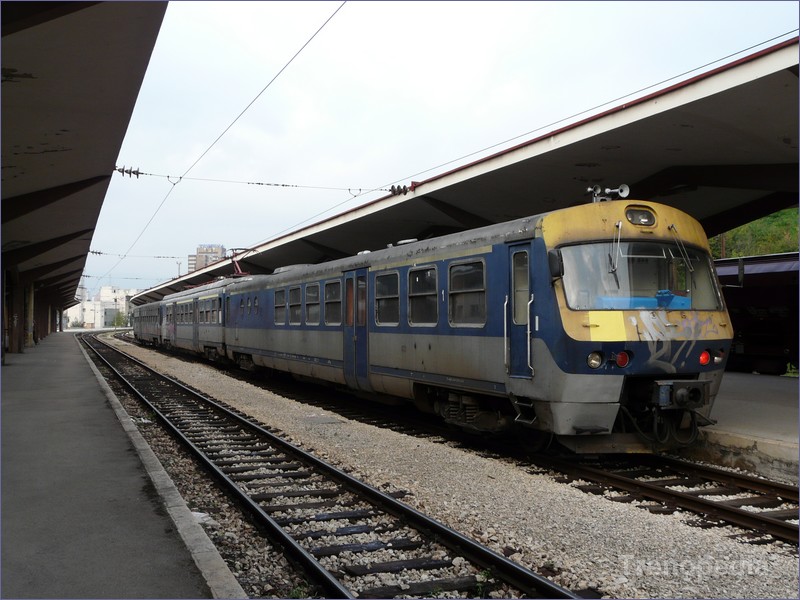
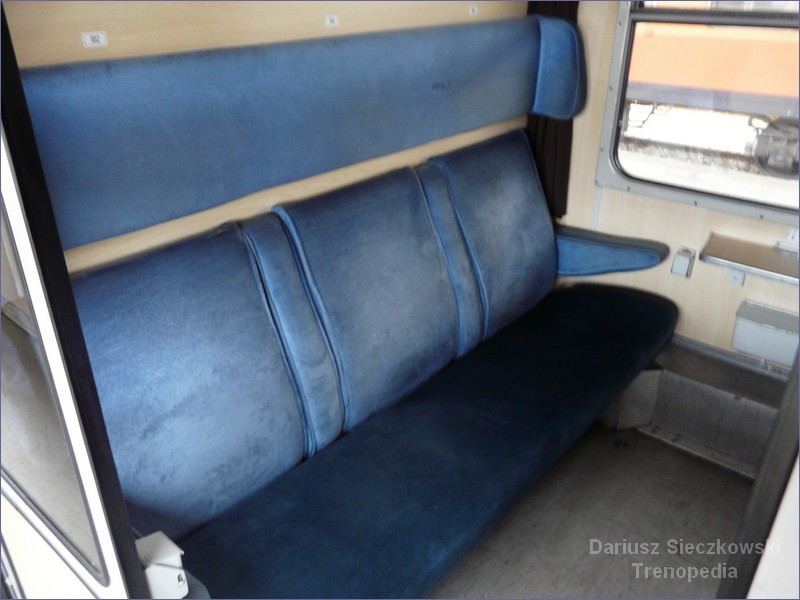
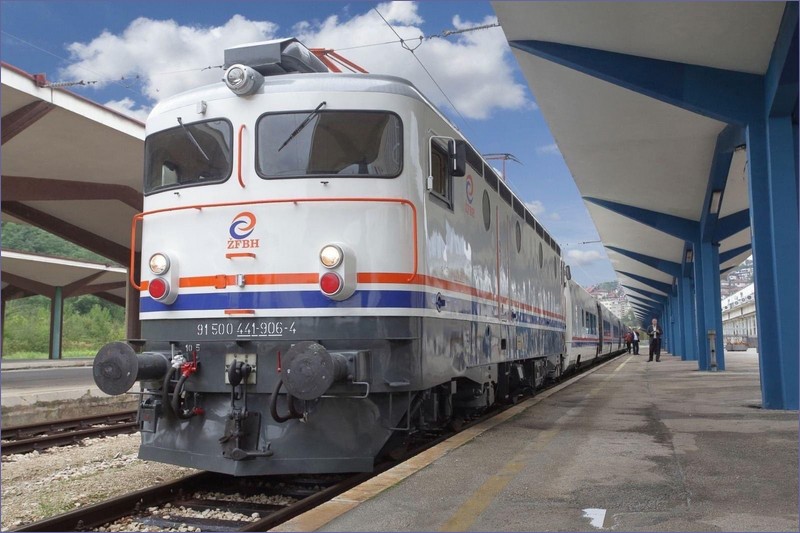
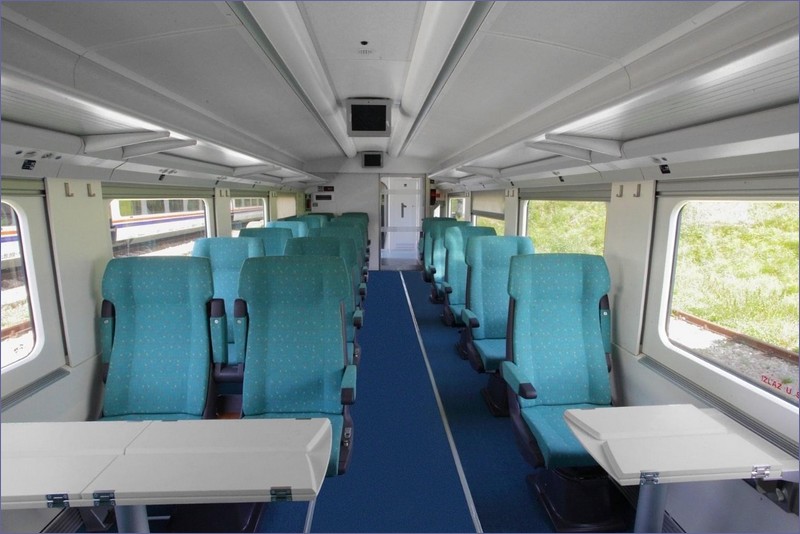
The quality of the rolling stock varies. There are old electric multiple units, rusty and dirty carriages, and modern air-conditioned Talgo trainsets for daytime trains and overnight trains (equipped with sleeping cars). In old carriages and multiple units smoking is allowed. In the Talgo trainsets smoking is prohibited.
I recommend the train ride from Sarajevo to Mostar. It is one of the most beautiful railway lines in Europe, the tracks run along the Neretva River. The views from the window are breathtaking.
Ticket prices are moderate.
Related articles:
Train from Sarajevo to Mostar – a passenger’s guide
Sarajevo train station – a passenger’s guide
Mostar train station – a passenger’s guide
Željeznice Federacije Bosne i Hercegovine – a passenger’s guide
Željeznice Republike Srpske (ŽRS) runs the following trains:
Doboj – Banja Luka
Doboj – Petrovo Novo
Banja Luka – Novi Grad
Banja Luka – Dobrlјin
Novi Grad – Dobrlјin
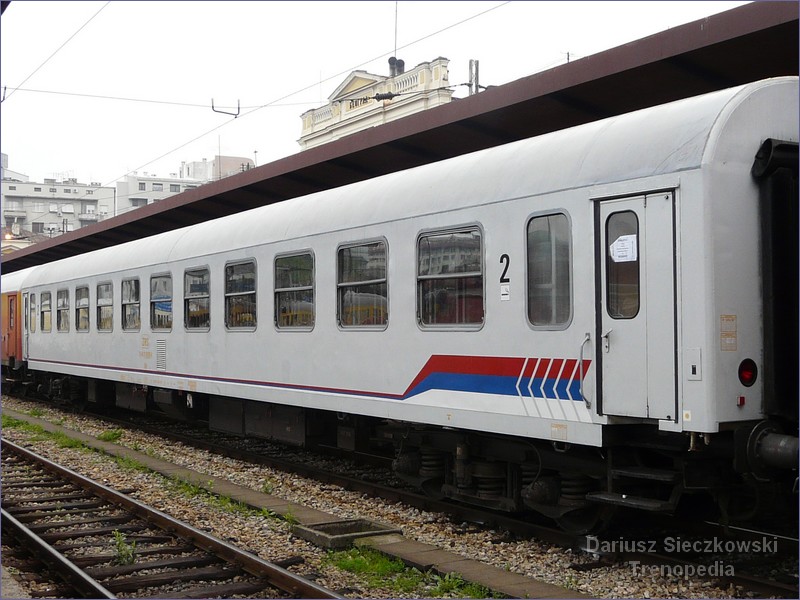
Rolling stock of the Željeznice Republike Srpske company is old, rusty and dirty. Smoking in compartments and in the corridor is allowed. No new trainsets or carriages have been purchased in recent years, and there are no plans to modernize the existing rolling stock. Railway enthusiasts will certainly be satisfied with ex-DDR carriages.
In December 2025 there were cuts in timetable.
Željeznice Republike Srpske – a passenger’s guide
Types of the trains in Bosnia and Herzegovina:
Lokalni voz – regional train. Usually electric multiple unit or old carriages. The cheapest option, stops at all stations.
Brzi voz – fast train. Stops at main stations only, comprised of Talgo trainset (Sarajevo – Mostar) or Ex-Swedish old but comfortable carriages (Sarajevo – Maglaj). Brzi voz Sarajevo – Bihać was suspended.
Train travel in Bosnia and Herzegovina – international trains
There is an only one passenger train between Croatia and Bosnia and Herzegovina. From December 2025 to mid-June 2026 the train runs on the following days:
Sarajevo – Ploče: Friday and Sunday
Ploče – Sarajevo: Saturday and Sunday
The train runs from 2022 during the summer season (June – August), on Fridays, Saturdays and Sundays. Train from Sarajevo to Ploče in Croatia is operated by Željeznice Federacije Bosne i Hercegovine. Talgo trainset departs from Sarajevo in the morning and returns in the evening. The journey takes more than three hours in one way. Train covers the distance 194 km. Seat reservation is compulsory. Tickets are not cheap, but it’s a scenic ride with beautiful landscapes.
Tickets must be purchased at least one day in advance – when purchasing, you must provide your name, surname and passport number.
Passenger train from Zagreb to Sarajevo is cancelled. There have been information about plans to reinstate the train for many years but the train is still not running.
Train from Belgrade to Sarajevo was suspended many years ago.
A short section of a Belgrade – Bar railway line of passes through Bosnia but the trains don’t stop on the territory of Bosnia and Herzegovina.
All narrow gauge railways from Bosnia and Herzegovina to Montenegro were closed and dismantled.
Trains between Croatia and Bosnia and Herzegovina – a comprehensive guide
Trains between Serbia and Bosnia and Herzegovina – a comprehensive guide
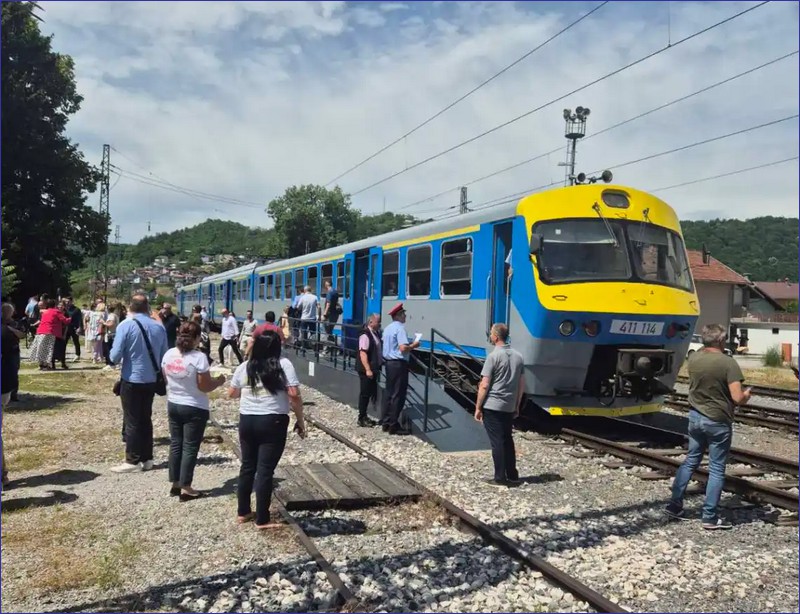
Tourist train Bihać – Bosanska Otoka
Tourist train from Bihać to Bosanska Otoka was inaugurated in 2026. The train runs on weekends in June, July and August. The train passes scenic Una river valley – the railway line is currently closed for schedule passenger trains.
One-way tickets cost 2 KM (about 1 EUR)
The train is operated by Željeznice Federacije Bosne i Hercegovine. Old diesel multiple unit which serves tourist train is not equipped with air-conditioning and is not accessible for people on wheelchairs. There is a toilet on board.
Train travel in Bosnia and Herzegovina – what to see:
Almost all interesting cities of Bosnia and Herzegovina reached by railway lies along the Sarajevo – Mostar railway. There are many possibilities to organize a hiking on mountan trials from the train stations.
Sarajevo – the capital and largest political, cultural and historical centre of Bosnia and Herzegovina. Its urban history was strongly shaped by Ottoman, Austro-Hungarian and Yugoslav periods. Most beautiful district in the Sarajevo is a Baščaršija – historic Ottoman bazaar with famous wooden fountain Sebilj and the traditional heart of the city. The city has an Oriental atmosphere and charm. There are many important landmarks such as beautiful Town Hall, Gazi Husrev-beg Mosque or Latin Bridge associated with the assassination of Archduke Franz Ferdinand in 1914. In National Museum of Bosnia and Herzegovina visitors can see important archaeological, historical and natural-history collections. I like this city very much.
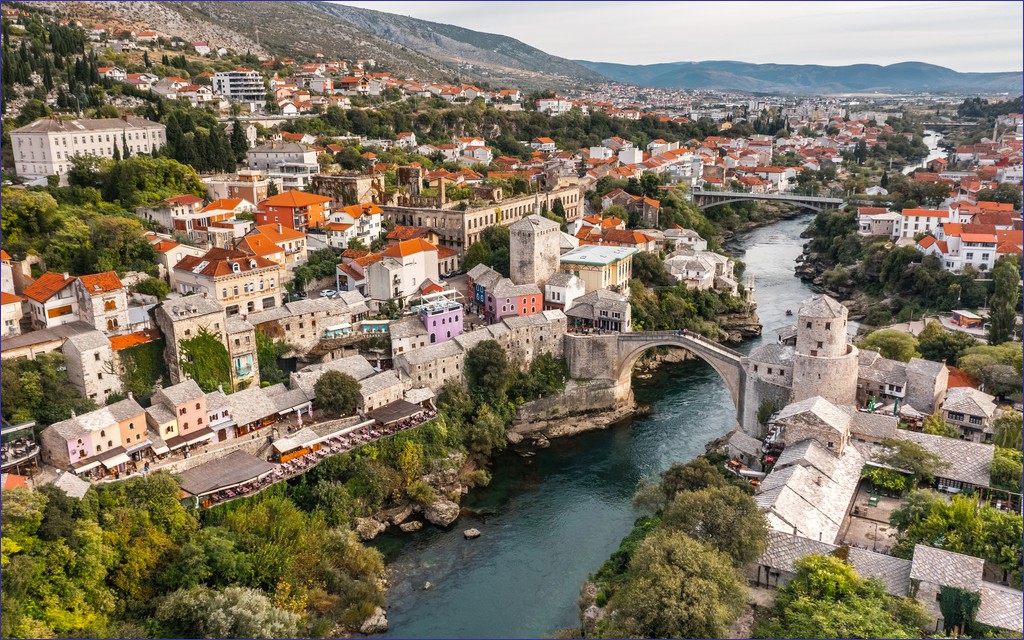
Mostar – one of Bosnia and Herzegovina’s most famous tourist destinations flooded with tourists. It developed along the Neretva River, around an important crossing of the river. Mostar’s most famous landmark and a UNESCO World Heritage Site is an reconstructed Old Bridge on Neretva. There are also another important landmarks, for example Old Bazaar (Kujundžiluk) – atmospheric Ottoman-era street with traditional shops and restaurants, Koski Mehmed Pasha Mosque, Partisan Cemetery, Old Town featuring mixture of Ottoman architecture, stone streets and traditional houses, some well-preserved Ottoman houses and examples of Austro-Hungarian architecture.
Konjic – a town on Neretva River famous for Old Bridge, elegant Ottoman stone bridge built in 1682 and reconstructed after its destruction in 1945, compact Old Town and Tito’s Bunker – enormous Cold War underground military complex built in secret near Konjic. Today it is one of the most unusual historical attractions in the region. Mithraeum is a Roman-era sanctuary dedicated to the god Mithras, discovered in Konjic.
Počitelj – a spectacular historic settlement on a steep rocky hillside above the Neretva River, approximately 25–30 km south of Mostar. It is one of the best-preserved historic urban ensembles in Bosnia and Herzegovina and is on Bosnia and Herzegovina’s UNESCO Tentative List. Most important landmark is the Počitelj Fortress – medieval defensive complex dominating the valley. The settlement features traditional stone houses and narrow lanes on the slopes and Ottoman-era monuments: Hadži-Alija Mosque, Gavrankapetanović House, historic Turkish bath and Medresa – former Islamic theological school. Počitelj is located near Čapljina where is the railway station.
Banja Luka – the second-largest city in Bosnia and Herzegovina and the administrative centre of Republika Srpska. One of the most important events in modern Banja Luka’s history was the 1969 earthquake, which severely damaged the city and led to a major reconstruction programme. The rebuilding transformed much of the urban landscape and resulted in numerous examples of Yugoslav modernist architecture. Some of the important monuments survived the earthquake and demolitions. You can visit Kastel Fortress – historic fortress on the banks of the Vrbas, with Roman, medieval and Ottoman layers, Cathedral of Christ the Saviour, Ferhadija Mosque, Banski Dvor – monumental 1930s building and important cultural centre or take a trip to Krupa na Vrbasu – scenic village and monastery south of the city, with waterfalls and old mills. The main railway station is located far from the city centre.
Funiculars and lifts in Bosnia and Herzegovina
There is an only one lift in Bosnia and Herzegovina, located in Sarajevo
Kosi lift is located in the Ciglane residential district, a steeply sloping neighbourhood north of the city centre. The lift was built to provide pedestrian transport between different levels of the steep hillside settlement. Instead of climbing a large number of staircases, residents can use the inclined lift. The original Kosi Lift was put into trial operation on 18 May 1990. The City of Sarajevo financed its construction, while the Swiss company GEBAUER of Zurich carried out the works. It is essentially an inclined urban elevator, rather than a conventional vertical lift or a funicular railway. This makes it a particularly interesting example of adapting public transport to difficult terrain.
The original system had lower, middle and upper stations, allowing residents of the different levels of Ciglane to avoid the steep stairways. The lift was repaired after the Bosnian War and returned to service in November 1998. A new panoramic cabin and reconstructed system were completed in the late 2010s. The reconstructed lift has a capacity of 20 people or 1,500 kg.
In 2026 the lift was temporarily suspended due to technical issues.
Interesting facts about railway in Bosnia and Herzegovina
– the largest city without passenger trains in Bosnia and Herzegovina is Tuzla (about 80000 inhabitants). There are plans to reinstate passenger services in the nearest future, but I doubt if one of two operators will run trains to Tuzla.
– in the past, there was an interesting narrow-gauge railway from Gabela (between Mostar and Metković) to Zelenika (present-day Montenegro) with a couple of short branches, later extended to Nikšić. The railway led, among others, through Dubrovnik and Herceg Novi. The line was eventually closed in 1976 due to road traffic, which was faster and cheaper than railway. Once every few years media publish articles about plans of reconstruction dismantled line, but there are only dreams.
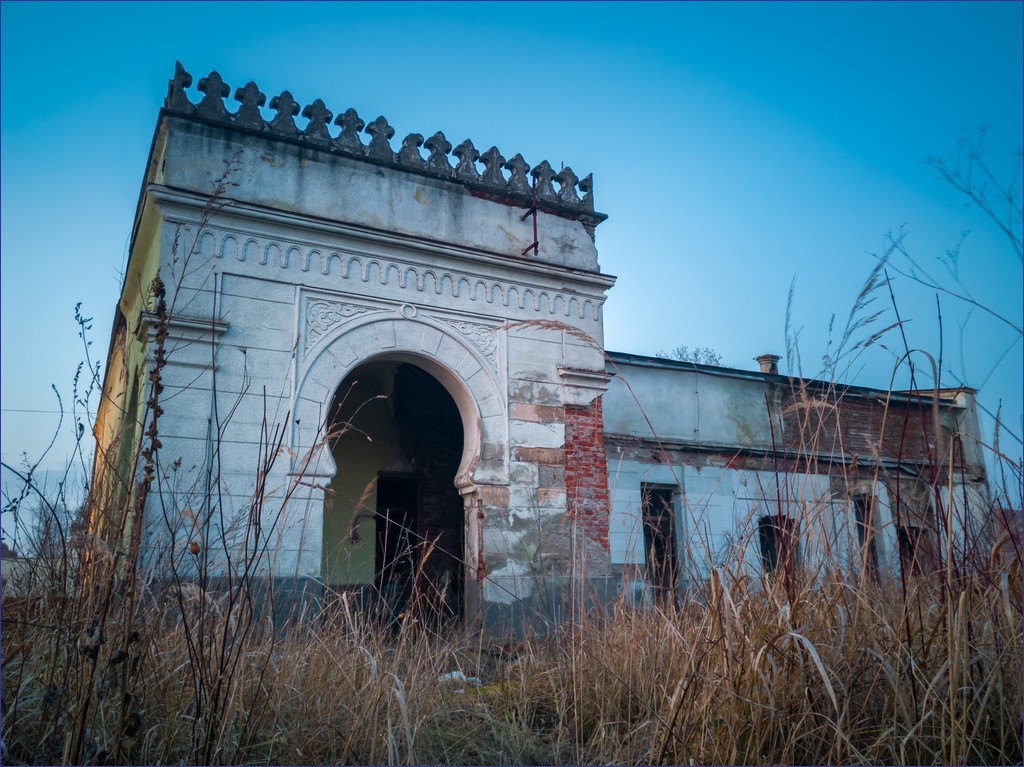
– Bosanski Brod has a beautiful railway station constructed in 1896. A building in the pseudo-Moorish style was inspired by architecture of official buildings in Afghanistan.
The station was razed to the ground during the heavy air raid on Brod on January 19, 1945. There was also a 3,5 km standard-gauge railway line connecting Bosanski Brod and Slavonski Brod (present-day Croatia)
– The railway line Bosanski Brod – Sarajevo was the first narrow-gauge railway line in present-day Bosnia and Herzegovina. The railway was opened in stages between 1879-1882. The first standard-gauge line was between Banja Luka and Dobrljin (December 1872).
– There was also an interesting narrow-gauge railway line Lašva – Jajce/Uskoplje. The line was eventually closed in 1976.
– A railway station in Sarajevo is a large station which handles only a dozen trains a day. The station was built between 1947 and 1952 by architects from Czechoslovakia and East Germany, the station was one of the most modern in Europe when it open.
– The first railway station in Sarajevo was constructed in 1882 and served narrow-gauge railways. The station was demolished and on this site house estate was build.
– All narrow-gauge railways in Bosnia and Herzegovina have been dismantled or converted to standard-gauge between 1966 and 1978.